Preface
Who This Book Is For
This book is for anyone who wants to understand how machine learning systems actually work, from the mathematics that define a neural network to the hardware that executes it and the engineering decisions that make it run efficiently.
Most readers will not become ML hardware architects or compiler engineers. Yet every practitioner who builds, trains, optimizes, or deploys a model makes decisions that depend on understanding the system beneath the code. This book provides that systems foundation for undergraduates encountering ML systems for the first time, practicing engineers strengthening their foundations, and researchers who need to reason about performance and deployment.
Why a Systems Textbook
In 1968, a NATO conference in Garmisch, Germany, helped establish software engineering as a distinct discipline amid concern that software systems had become too complex for ad hoc programming (Naur and Randell 1969). Reliable software required its own principles, methods, and rigor. Decades later, Hennessy and Patterson made quantitative analysis central to computer architecture education, systematizing how engineers measure, predict, and optimize processor performance (Hennessy and Patterson 2017). Both examples show how shared methods make complex engineering work systematic and teachable.
Machine learning faces its own Garmisch moment.
For the past decade, ML research has been dominated by model-centric thinking focused on discovering new algorithms and architectures. That focus matters, but a model is not a system. A neural network that performs well in a research notebook is useless if it can not meet latency constraints, if its data pipeline can not handle the required volume, or if its energy cost exceeds its economic value. The gap between a working model and a production system is not merely an implementation gap; it is a gap in fundamental engineering principles.
This book treats ML systems engineering not as a collection of tools, such as Kubernetes, PyTorch, and CUDA, but as a discipline grounded in quantitative bounds, models, and design principles. Just as civil engineers rely on foundational physics and structural principles, AI engineers must make the governing principles behind each system model explicit:
- The iron law of ML Systems: A decomposition of movement, compute, and overhead, with overlap handled by the critical path.
- Data Gravity: The placement pressure created by large data volumes and constrained networks.
- Energy Accounting: Per-event costs and event counts determine whether movement or computation dominates.
- Amdahl’s Law: The serial fraction of a pipeline caps total system speedup.
Computer science studies what is computable. ML research studies what is learnable. AI engineering studies what is buildable, given the physics of real hardware and real data.
I wrote this book to help build that foundation and to do for AI systems what Hennessy and Patterson (2017) did for computer architecture: replace intuition with measurement, and art with engineering. The goal is to teach system-level reasoning before implementation, treating data, algorithms, and hardware not as separate silos but as a single, coupled optimization problem.
Consider a box of LEGO bricks. The same interlocking pieces build a spaceship, a castle, or an entire city. The sets change; the bricks do not. ML systems work the same way. A convolutional network for image classification, a transformer for language generation, and a reinforcement learning agent for robotics are vastly different applications, but beneath them sit the same building blocks: computational graphs, memory hierarchies, data pipelines, optimization loops, and the trade-offs between latency, throughput, and energy. Mastery of those building blocks makes unfamiliar systems legible.
That is why this book teaches enduring principles rather than current tools. Dominant frameworks have shifted from Theano to TensorFlow to PyTorch in under a decade. Hardware has evolved from repurposed graphics processors to purpose-built tensor accelerators, with new architectures emerging every year. Any textbook that teaches today’s tools will be obsolete before its next edition. The building blocks endure.
What This Book Covers
This book centers on the single compute node: one host with one to eight accelerators, typically with discrete device memories connected by an interconnect. It also introduces multi-accelerator training and production operations where they clarify node-level design; fleet-scale treatment lies outside its scope.
The content is organized into four parts, each with a distinct role in the systems argument:
- Part I: Foundations of ML Systems develops the vocabulary, mental models, and end-to-end workflow that guide every ML project, from the characteristics that distinguish ML systems from traditional software through the data engineering pipelines that feed them.
- Part II: Development and Training connects mathematical foundations to working systems through deep learning computation, neural architectures, frameworks, and training procedures.
- Part III: Optimization and Acceleration addresses data efficiency, model compression, hardware acceleration, and the benchmarking methodology needed to measure progress rigorously.
- Part IV: Deployment and Operations covers serving infrastructure, operational practices, and responsible engineering for systems that must be fair, transparent, and trustworthy in production.
These four parts trace a path through the ML Systems Stack, a layered abstraction modeled on the classical computer systems stack. Each layer provides an abstraction to the layer above and consumes the layer below: from hardware at the bottom through frameworks, models, training, and serving, up to operations and applications at the top. Data flows through all layers as a cross-cutting interconnect, much like a data bus in computer architecture.
Throughout the book, a margin figure highlights which layers each chapter addresses, providing a recurring map of the stack.
The data bar alongside the stack is not merely decorative. Its uniform shading reflects how central data is to each chapter’s concerns, a separate dimension from the layer intensities. The connecting wires between each layer and the data bar show which layers interact with data in that chapter’s context. Three chapters illustrate how the lens shifts.
In Hardware Acceleration, the layer intensity concentrates at the bottom of the stack while the data bar is faint: the chapter is about silicon, not data. In Model Training, the middle layers glow and the data bar is moderately lit, reflecting that training consumes data but is fundamentally about optimization. In Responsible Engineering, the top layers dominate and the data bar carries a moderate tint, because biased training data surfaces as biased applications even though several layers sit between them. The same stack tells three different stories, with data as an independent dimension.
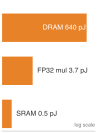
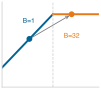
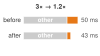
The margins also carry small visual notes at the point where a relationship is easiest to understand by sight. These are not numbered figures to cite later; they are reading aids. A ladder makes a scale gap visible, a trend sketch shows direction, a roofline thumbnail locates a bottleneck regime, and a dominance bar shows which term controls a total. When a miniature uses a log scale, it says so inside the image.

Each part builds on the previous one. Sequential reading is recommended for those new to the field, while the following tailored paths support specific professional goals:
Suggested Reading Paths
Readers with different backgrounds and goals may benefit from tailored paths:
- The Complete Path (all chapters, in order): For undergraduates and readers new to ML systems. Start with Part I, then progress through Parts II, III, and IV. This path develops every concept from first principles.
- The ML Engineer’s Path (systems depth for practitioners): For engineers who already train and deploy models but want to understand the systems underneath. Skim Part I for vocabulary, then focus on ML Frameworks, Model Training, Hardware Acceleration, Benchmarking, and Model Serving.
- The Optimization Path (efficiency-focused): For engineers working on model efficiency, edge deployment, or resource-constrained systems. After Part I, move directly to Data Selection, Model Compression, Hardware Acceleration, and Benchmarking.
Conventions
This book uses a small set of typographic conventions to mark what each piece of prose is doing.
Bold marks first definitions
A term in bold within body prose is its formal first introduction in the volume. Each term receives this treatment exactly once. Subsequent appearances are unbolded; by then the term is part of the working vocabulary the chapter carries forward.
Every machine learning system has a dual mandate: it must manage statistical uncertainty and physical constraints simultaneously.
The bold is a contract: register this term because it will recur. A matching index entry in the back of the book points to the defining occurrence (under the definition subentry), providing a way to return to it. Key technical terms are also compiled in the glossary.
Bold also appears in a second, structural role: as a functional label at the start of an item inside a callout box or a summary bullet—for example, Recommendation, Trade-off, or Result. In that context, the bold is scaffolding rather than a first definition.
Italics carry specific rhetorical jobs
Italics are not used for general emphasis. Every italic span in this book performs one of a small number of specific jobs:
- Direct opposition: training vs. inference, logical vs. physical.
- Impossibility, stated as physical, mathematical, or logical law: “sub-10 ms systems cannot use distant cloud infrastructure—physics forbids it.”
- Word used as word: “the term gradient refers to a vector of partial derivatives.”
- Titles of works: Computer Architecture: A Quantitative Approach.
- Thesis punchline: A single italicized sentence that captures the controlling insight of a section, for example Data is Source Code.
An italicized word is performing one of these jobs. A word that is not italicized carries no implicit emphasis.
Callouts have visual identities that match their job
Callout boxes are not decoration. Each type signals a specific kind of content, so the visual identity announces what the box contains before the reader engages with it.
| Callout | Contains |
|---|---|
| Definition | Formal definition of a key term, with its significance, distinction from the nearest neighbor concept, and a common pitfall |
| Example | Historical case or concrete scenario, structured as context, insight, and systems lesson |
| Systems Perspective | Analytical observation or mathematical nuance that enriches the surrounding argument |
| Napkin Math | Worked calculation walked through step by step, with values computed inline from the book’s constants; intermediate tables and equations are the math itself |
| Checkpoint | Self-check questions to verify understanding of the preceding section |
| War Story | Documented engineering incident with a sourced failure mode, structured as context, failure, consequence, and lesson |
| Lighthouse | Recurring workloads characterized by a profile (parameters, FLOPs, dominant constraint), used as anchored case studies across multiple chapters |
| Principle | Canonical book principle or invariant referenced from later chapters |
| Theorem | Formal, equation-backed result or bound, stated with its conditions and applied in later quantitative analysis |
| Key Takeaways | Four to seven most important results from a chapter, in summary form |
| Learning Objectives | Skills and concepts that readers should be able to explain or apply after completing the chapter |
| What’s Next | Bridge from the chapter just ended to the chapter beginning, naming the open question the next chapter addresses |
When a callout contains a table, figure, or equation, that artifact is part of the callout’s pedagogical unit, not decoration. A lighthouse’s profile is its characterization. A napkin math box’s intermediate tables are the worked math. Reading these as separated artifacts loses the teaching arc. Standalone reference tables, by contrast, sit between paragraphs as numbered artifacts the reader returns to through cross-references. Both forms are valid; the visual marker (callout vs. standalone) tells the reader which one they are looking at.
Whichever path readers follow, the text is meant to connect with supporting resources beyond the chapters themselves.
A Learning Platform
This book is one component of a broader learning ecosystem. The complete text, interactive notebooks, lecture slides, exercises, hands-on labs, and supplementary materials for every chapter are freely available at mlsysbook.ai.
An Open-Source Textbook
This book is open source. The full text, figures, and build system are available at mlsysbook.ai/git, and I invite every reader to contribute. That openness is deliberate. If AI engineering is to become a shared discipline rather than a collection of isolated practices, its foundational texts must be accessible to everyone. ML systems is a field shaped by practitioners across industry, academia, and the open-source community worldwide. A textbook covering this field should reflect that breadth and be available to all, regardless of geography or institutional affiliation.
Contributions from readers, whether fixing an error, suggesting a clearer explanation, adding a worked example, or proposing new content, have materially improved every chapter. Issues and pull requests provide the mechanism for that collaboration. This book improves because its readers participate in building it.
Prerequisites
Readers should bring two prerequisites:
- Programming: Fluency in Python, including functions, classes, and basic data manipulation with NumPy.
- Mathematics: Comfort with linear algebra, basic calculus, and probability at the undergraduate level.
Two additional areas are helpful but not required:
- Computer systems: Familiarity with memory hierarchies and basic computer architecture deepens the optimization and hardware chapters.
- Machine learning basics: Prior exposure to supervised learning concepts provides useful context, but Part II develops the necessary foundations from first principles.
Beyond This Book
This book develops the single-node foundation while introducing distributed execution, production operations, and governance where they affect the end-to-end system. Advanced multi-node topologies, fleet-wide collective algorithms, and cluster resilience extend into distributed systems at scale. Completing this text prepares readers to navigate that broader engineering landscape.
Using This Book in a Course
This book grew out of CS249r at Harvard University and the TinyML edX professional certificate program. The TinyML course taught ML systems at the most constrained end of the spectrum: microcontrollers running on milliwatts with kilobytes of memory. It revealed a surprising lesson. The fundamental constraints that govern tiny devices (memory bandwidth, compute density, energy per operation) are the same constraints that govern data center GPUs. The physics scales; only the numbers change. That insight shaped this book. What began as a course on resource-constrained ML matured into a comprehensive treatment of ML systems engineering, grounded in the principle that mastery of the fundamentals at any scale prepares engineers for every scale.
In course settings, the book is designed to support a one-semester sequence covering the full ML systems stack. Instructors may also select individual parts for shorter modules:
- Parts I–II form an introductory half-semester on ML systems foundations and how such systems are built and trained.
- Parts III–IV form an applied half-semester on optimizing, deploying, and operating them.
For survey courses or executive programs, the four part introductions alone provide a condensed overview of the quantitative principles that govern ML systems.
Lecture slides, assignments, and instructor resources are available at mlsysbook.ai.